Showing posts with label Samsung. Show all posts
Showing posts with label Samsung. Show all posts
Monday, August 31, 2015
Galaxy Note: A tablet in a smartphone
Despite a slew of launches (numerous versions of the iPad and iPod) by Apple, we still consider the mind blowing Samsung Galaxy Note to clearly be ‘the gadget of the year’, even though the gadget is a tablet packed inside a smartphone.
The Galaxy Note’s a heady mix of a tablet and a smartphone.
 |
| The Samsung Galaxy Note. |
And yes, after bringing in the hefty Galaxy Tab for which Samsung had to face a lawsuit a few months back, the Korean company has come a long way with the Galaxy Note, a new invention that puts it in between a tablet and a smartphone.
The Note may be termed a tablet which is convenient to carry and use, just like a mobile phone.
The Galaxy Note is 5.3 inches in size and holding it on your palm wouldn’t be much of a bother. The Galaxy Note is bigger than the already hefty Galaxy Nexus, whose 4.65 touchscreen was till recently the biggest in the market.
Samsung prefers to call the Galaxy Note a high-end smartphone rather than a tablet as it can allow normal phone operations while on the go.
The Galaxy Note’s stylus-oriented interface will allow you to take notes. This amazing gizmo lets you draw and you can take screen caps also. You can do things like take a photo of say a house, draw a tree and combine the images, giving it a realistic look. And even send it by email.
With the onset of 3G, video calls are the talk of the town everywhere. But users, who’ve had the opportunity to own a Samsung Galaxy Note, say that with the device it is possible to make video calls with 2G SIM cards and get high-quality resolution video.
The mind boggling features of the Galaxy Note include an 8-mega pixel camera, geo-tagging, touch focus, face and smile detection, image stabilisation Android OS, v2.3.5 (Gingerbread) talk time of up to 26 hours and 10 min (on 2G) and up to 13 hours 30 minutes (on 3G) and memory card up to 32GB, among others.
It features a 5.3-inch HD Super AMOLED screen, the largest in any phone available in the market. The Note is powered by a 1.4GHz dual-core processor.
Samsung also has some other smartphones like the Galaxy S II and the Galaxy Nexus.
There is buzz that the Samsung Galaxy S II can be updated to Android 4.0.1 Ice Cream Sandwich build XXKP2.
There is also the Galaxy Nexus, one of Samsung’s USPs. Comparing the Nexus with the Galaxy S II, we see that the Galaxy Nexus comes with the superior AMOLED display, while the Galaxy S II has super LCD display. Additionally, Galaxy Nexus has a display of 4.65-inches, against the 4.3-inches of Galaxy S II.
Galaxy S II comes with a resolution of 800 x 480 pixels (218 pixels per inch), while the Galaxy Nexus has 1,280 x 720 pixels, which is far superior.
As far as the Galaxy Note goes, Samsung is set to sell over a million units and could stay as a trendsetter (by creating a new category in the tablet-smartphone market) before we see the likes of Sony, Motorola, LG, or for that matter, even Apple, bring in devices that could be a tablet as well as a smartphone.

Galaxy S5: Samsung’s yet another move to stay on top
Samsung has made yet another big move in a bid to stay on top in the smartphone segment – it has just said that it would roll out the Galaxy S5, the company’s flagship Android handset, in the country in about 15 days.
According to Samsung, the price of the Galaxy S5 would be from Rs 51,000 to Rs 53,000. Customers who want the phone early can get it at online stores or from select retailers by shelling out an amount of Rs 1,500 as initial payment.
 |
| The Samsung Galaxy S5. |
The Galaxy S5 will come in four colours – black, white, blue and gold.
Samsung has changed the processor (in the Galaxy S5) compared to the S4 and the new octa-core CPU of the S5 can have all the eight cores running at the same time.
Just like the earlier versions of top Galaxy handsets, Samsung Galaxy S5 will come with an 8-core Exynos processor in India.
The 4-core Qualcomm Snapdragon processor would propel the global version of the Samsung Galaxy S5. But the user will not find any difference between the two versions.
The three main features that come with the Galaxy S5 are a heart rate sensor, a fingerprint scanner and a body, which is both water as well as dust proof.
The Galaxy S5 comes along with premium hardware like the Exynos processor (as mentioned earlier), which operates four high-performing cores at 1.9 GHz and low-powered cores operate at 1.3 GHz. The S5 has 16 or 32 GB internal storage options with support for 64 GB via a microSD card.
The phone is offered with a 5.1-inch SuperAMOLED screen with a resolution of 1080 x 1920 pixels, 16 MP main camera and 2 MP front camera along with 2 GB of RAM. It is propelled by Android 4.4.2, which happens to be the latest version of the operating system.
The S5 comes with a 2,800 mAh battery, which is pretty powerful. The Samsung Galaxy S5 will vie with top-end phones, some of which would be launched soon, like the HTC One M8, the LG G3 along with the Sony Xperia Z2.
Samsung also plans to roll out the Galaxy Gear Fit in about 15 days time. The Galaxy fit will have a band that also plays the role of a smartwatch and will be available for Rs 15,900.
Samsung would also launch the Galaxy Gear 2 for Rs 21,900 and Galaxy Gear 2 Neo for Rs 15,900 soon.
With the Galaxy S5 and other new handsets, Samsung is making every effort to keep its market share intact and stay on top.
Sunday, August 30, 2015
Samsung, HTC set to intensify smartphone war
The global smartphone market is raging, with the company offering the most in terms of variety emerging the winner, and in the latest move, Samsung Electronics has unveiled three smartphones globally based on the Bada operating system while HTC has come up with a glassless 3D smartphone in India, the price of which is pretty steep.
The models rolled out by Samsung include a new flagship handset the Wave 3, which includes a software client for its new messaging service ChatOn that will roll out from September.
ChatOn is a service that allows users to chat with friends and family. There is no charge for this service and will be available across all major smartphone operating systems as well as tablets and laptops, according to Samsung.
The Wave 3 will come for $450 and could be available from next year. The wait for Indians could be another three months, that is, around March next year.
The phone connects to Internet via Wi-Fi or high-speed packet access or HSPA and can download data at up to 14.4M bps and upload at up to 5.76M bps.
The smartphone runs on Bada 2.0 software, which supports Wi-Fi Direct, a technology and certification mark managed by the Wi-Fi Alliance that paves the way for devices that are compatible to connect directly to each other in order to share content.
Bada is the home-grown operating system of Samsung and has surpassed Microsoft’s Windows Phone, selling two million handsets in the second quarter.
The Wave 3, which has a metal case, comes with a 4-inch Super AMOLED display, a 1.4 GHz processor and a 5 megapixel camera that has a LED flash. The camera is also capable of shooting video at 720 p.
The eclectic features of the Wave 3 include content sharing and a facility that enables users to send messages to a group of users. The Interaction Rank feature allows users to see how often they communicate with their friends and associates.
Samsung also unveiled the Wave M and Wave Y, which are based on Bada 2.0 and come with Near-Field Communications or NFC as an option.
HTC glassless 3D smartphone
Taiwanese handset maker HTC Corporation has rolled out a glass-free 3D smartphone in India for a whopping Rs 35,990. The HTC EVO 3D comes with Google Android Gingerbread 2.3 operating system.
The smartphone has Qualcomm’s latest MSM 8660 Snapdragon system on a chip running at 1.2 GHz, with an Adreno 220 graphics engine, a one GB RAM and 32 GB of onboard storage.
HTC India country head Faisal Siddiqui averred, “We will collaborate with Qualcomm to present the EVO 3D, the first smartphone in India with a superior 3D viewing, and that too without glasses. We are confident that the phone will set a benchmark for 3D viewing in India.”
HTC could find quite a few takers owing to its glassless and superior 3D features even though it is priced high but if Samsung delays the commercial launch of its three smartphones, it could dent the company’s prospects as competitors could roll out eclectic hi-tech handsets and intensify the slugfest in the smartphone market.
Friday, August 28, 2015
Samsung upgrade plan: New Galaxy Note 3 Neo and Galaxy Grand Neo launched
Samsung is again on a launch as well as an upgrade spree and has rolled out two smartphones in the country, the Galaxy Note 3 Neo and Galaxy Grand Neo for Rs 40,990 and Rs 18,450.
Both the Galaxy handsets will be available from the end of this month.
 |
| The Samsung Galaxy Note 3 Neo. |
Samsung Galaxy Note 3 Neo features a 5.5-inch HD (720x1280 pixels) Super AMOLED display, 2 GB RAM, 16 GB in-built storage, which is can be expanded up to 64 GB via a microSD card and comes with a 3,100 mAh battery.
The Galaxy Note 3 Neo comes with an S Pen stylus, similar to the Samsung's Galaxy Note phablet.
The Galaxy Note 3 Neo is propelled by a hexa-core processor, which is dual-core 1.7 GHz Cortex A15 along with quad-core 1.3G Hz Cortex A7. It operates on Android 4.3 Jelly Bean out-of-the-box.
The Note 3 features an 8-megapixel rear camera along with LED flash and BSI sensor, while there is a 2-megapixel front-facing camera, which is also with the same sensor.
Connectivity options on the device are Wi-Fi, GPS, GLONASS, NFC, Infrared, Bluetooth and 3G.
The Samsung Galaxy Note 3 Neo is loaded with apps that include Samsung Apps, Samsung WatchON, Samsung ChatON, Samsung Link, screen mirroring, S Voice, S Health, Group Play, Smart Scroll, Smart Pause, Air View, Story Album and S Translator.
The Galaxy Note 3 Neo will be offered in Black, White and Mint Green. There is also an S Pen, which comes with Air Command and Easy Clip feature.
The Note 3 Neo also allows access to Club Samsung content store, where music, movies and mobile TV, among others, are available in nine Indian languages.
The Note 3 Neo also allows access to Club Samsung content store, where music, movies and mobile TV, among others, are available in nine Indian languages.
Galaxy Grand Neo
The Galaxy Grand Neo is a dual-SIM dual handset with a 5.1-inch TFT display along with WVGA of 480x800 pixel resolution. The Android 4.2 Jelly Bean-based smartphone is propelled by a 1.2 GHz quad-core Cortex A7 processor and comes with 1 GB RAM.
 |
| The Samsung Galaxy Grand Neo. |
The Galaxy Grand Neo is offered with a 16 GB storage, which can be expanded up to 64 GB. The handset supports 3G along with Wi-Fi 802.11 b/g/n (2.4GHz), Wi-Fi direct, Bluetooth 4.0 LE, GPS/AGPS connectivity.
The Grand Neo smartphone’s dimensions are 143.7x77.1x9.6 mm and weighs 163 grams.
The Galaxy Grand Neo has been fitted with a 5-megapixel rear camera and a VGA 0.3-megapixel front-facing camera. It also has LED-flash support and there is an auto focus rear camera with 720p video recording capability.
Galaxy Grand Neo is run by a 2,100 mAh battery, which can last up to eight hours on 3G and up to 10 hours on Wi-Fi.
So, after the upgraded Galaxy Note 3 Neo and Galaxy Grand Neo, Samsung is offering a wider variety of handsets and is cementing its top position in the country’s smartphone market.
Samsung Galaxy Trend, Star Pro and Sonia Xperia C may stir up markets
Samsung is further beefing up its market share by rolling out higher versions of its existing phones (like Nokia’s Lumia series) and has brought in an upgraded handset of the Galaxy Star named Galaxy Star Pro and even launched a new phone, the Galaxy Trend, but will the Xperia C phablet by Sony find many takers (the price though is pretty judicious)?
The Galaxy smartphone, Samsung Galaxy Trend, comes at a price of Rs 8,290, while the Samsung Galaxy Star Pro has a price tag of Rs 6,750.
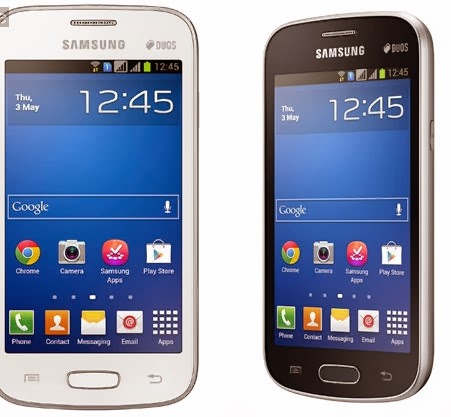 |
| Samsung Galaxy Star Pro and Galaxy Trend. |
The Samsung Galaxy Star Pro operates on the Android 4.1 Jelly Bean and supports dual-SIM (GSM+GSM).
This is something phenomenal (supporting GSM as well as CDMA). It also offers features like a 4-inch WVGA (480x800) display and is propelled by a 1 GHz Cortex A5 processor.
The device comes with 512 MB RAM and 4 GB built-in storage, which can be expanded up to 32 GB via a microSD card.
The Samsung Galaxy Star Pro comes with a 2 megapixel rear camera and no front facing camera (and these features are a dampener). At least, the Star Pro should have had a 3 MP camera.
The Star Pro has a 1,500 mAh battery, which can offer up to 15 hours of talk time and 370 hours of standby time. The new Star Pro has a few preloaded apps like Samsung Apps, ChatON, mFluent IM and ActiveSync.
Galaxy Trend
Meanwhile, the Samsung Galaxy Trend is offered with a 4-inch WVGA 480x800 pixel TFT display and is propelled by a 1 GHz processor. It is a dual-SIM (GSM+GSM) smartphone and runs on Android 4.0 Ice Cream Sandwich with TouchWiz 4.0 UI on top.
The Galaxy Trend comes with a 3 megapixel rear camera but has no flash. An improved camera would have done Samsung a world of good though. But a few camera features such as single shot, panorama, smile shot, share shot, photo effects, white balance and timer do give the camera some variety though.
The Galaxy Trend has 512 MB RAM and 4 GB built-in storage but only 2.05 GB is accessible. Its storage can go up to 32 GB via a microSD card.
Connectivity features include Wi-Fi, Bluetooth, EDGE, GPRS and 3G. The Trend has a 1,500 mAh battery, which can offer up to 8 hours of talk time and up to 350 hours of standby time.
Sonia Xperia C
Sony Xperia C phablet has been priced pretty prudently at Rs 21,490 and is available in three different shades: white, black and purple.
The 5-inch qHD display of 960x540p resolution of the Xperia C comes with a 0.3 MP webcam and the flip side has an 8 MP camera with features such as 4x digital zoom, LED flash, auto focus, face detection and the ability to record good quality videos. Quite commendable!
The 5-inch qHD display of 960x540p resolution of the Xperia C comes with a 0.3 MP webcam and the flip side has an 8 MP camera with features such as 4x digital zoom, LED flash, auto focus, face detection and the ability to record good quality videos. Quite commendable!
 |
| The Sony Xperia C phablet. |
The phablet runs on the Android Jelly Bean 4.2.2 OS and would offer access to Play store as well as some Google mobile services.
It has a quad-core MediaTek MTK6589 processor with 1.2 GHz and this ensures smooth multitasking. It has 1 GB RAM.
Although there’s only 4 GB space, it can be expanded up to 32 GB via a microSD card. The Sony phablet offers talk time of about 10 hours in 3G mode and that’s phenomenal!
So Samsung, with its slew of mobile offerings (this time the Galaxy Trend and Star Pro), and Sony Xperia C (with its prudent pricing) could find a place in the highly-competitive gadgets market.
Wednesday, August 26, 2015
With Galaxy Tab 3, Samsung range of tabs will let it stay on top
Samsung has rolled out the Galaxy Tab 3 range of tablets, namely the Galaxy Tab 3 211, the Galaxy Tab 3 310 and the Galaxy Tab 3 311 in the country and has aggressively priced the gadgets from Rs 17,745 to Rs 25,725 in a bid to take on the litany of tablets being rolled out, especially by home-grown firms like Micromax.
The tablet market in the country is on the boil with 31 lakh tablets already being sold in 2012. And, the market is growing by leaps and bounds with sales growth likely to surpass over 100 per cent every year, for the next two years.
 |
| Samsung Galaxy Tab 3 range. |
The 7-inch Galaxy Tab 3 211 was unveiled in April. The Samsung Galaxy Tab 3 211, priced around Rs 17,800, is propelled by a 1.2 GHz dual-core processor along with a 1 GB RAM.
The 7-inch screen comes with a rather disappointing 1,024x600 resolution at a small 169 ppi.
The tablets will be offered in 8 GB or 16 GB storage options and are expandable by another 64 GB via a microSD card. Connectivity options on the Samsung Galaxy Tab 3 series are Wi-Fi, Bluetooth, USB and A-GPS/ GLONASS. The tablets run on Android 4.1 Jelly Bean.
The Galaxy 211 also comes with pre-loaded services such as My Education, My Offers, My Games, My Music and My Movies. Through My Education, a user can access 2,000 e-books, 1,000 learning videos and preparatory material for exams, among other apps.
The 8-inch Galaxy Tab 3 310 and Galaxy Tab 3 311 are powered by 1.5GHz dual-core processor and 1.5 GB RAM. They are loaded with a 5 MP rear camera and 1.3 MP front camera. The tablets have 8-inch WXGA TFT display with a resolution of 1,280X800 pixels.
Available in 32 GB and 64 GB versions, the tablets also come with expandable storage of up to 64 GB via a microSD card.
The tablets have a 4,450 mAh battery, which is highly powerful. The devices run on Android Jelly Bean 4.2 and come loaded with Samsung applications and services like Samsung Hub, ChatOn, S Translator, S Travel, Pop up Video and WatchOn.
Samsung Galaxy Tab 3 310 is the Wi-Fi variant of the tablet and carries a price tag of Rs 21,495 and Galaxy Tab 3 311 is a Wi-Fi + 3G tablet priced at Rs 25,725.
So, with a litany of choices and judicious pricing, Samsung is set to retain pole position in the Indian tablet market, where mainly home-grown makers like Micromax, with its budget tabs, pose a threat.
Samsung launches Wave, Omnia 652 handsets
Gung-ho about the prospects of the smartphone market worldwide, Samsung has jacked up global sales target to 25 million for this year and is also betting big on India by launching a slew of phones, including three new Wave handsets based on its Bada platform along with the Omnia 652.
The Samsung Wave series, that includes the 525, 533, 723 models, and Omnia 652 carry a price tag of Rs 8,800, Rs 9,900, Rs 13,500 and Rs 10,600 respectively in the country.
 |
| Samsung Wave 525 |
Meanwhile, the Samsung Omnia 652 operates on Windows 6.5 and comes with ActiveSync, which gives complete access to business push e-mail. It also allows users to organise their personal e-mails on Yahoo and Windows Live.
Already installed with the Microsoft Office 2010, phone users can view and edit PowerPoint presentations and create, view or edit Word and Excel documents. It has a QWERTY keypad, customisable homescreens and online widget support. This 3G (HSDPA) compatible device also has a video telephony camera.
The Samsung Omnia 652 integrates Wi-Fi, Bluetooth, USB, GPS and Internet Explorer 6. The handset has a 2.0 megapixel camera, YouTube Apps, Sound Alive, up to 16 GB of additional storage support and a 3.5 pi audio ear jack. The Omnia 652 has a 1,500 mAH battery that can provide a talk time of 12 hours and 600 hours standby time on 2G networks along with up to 7.3 hours talk time and 441 hours standby time on 3G.
 |
| The Omnia 652 |
Competition in the Indian smartphone market has become so intense with a litany of rollouts that Samsung had to halve prices recently in order to stay in the fray.
An entry-level smartphone in India comes for about Rs 6,500 as compared to Rs 12,000 last year. And smartphone makers, including Nokia, Samsung, LG, Dell, BlackBerry and HTC say prices are likely to plummet further as more and more people flock for these handsets and also with the 3G juggernaut rolling out. The 3G technology will pave the way for high-speed and seamless videos as well as internet on handsets.
Samsung’s strategy to connect with the youth with its colourful Corby series of phones, which had a slew of social networking features, along with its advertisement that stressed on the power of the youth, had paid off handsomely, helping the company register substantial earnings.
Even in India’s smarphone market, Samsung is a dominant player and offers the widest variety in this category, much more than rivals Nokia and even BlackBerry (which mainly caters to the high-end variety). With its strategy to flood this segment with more handsets like the Samsung Wave 525, 533, 723 and Omnia 652, the Korean giant could look forward to retaining its dominant position in the Indian market.
Tuesday, August 25, 2015
Samsung’s upgraded Galaxy Grand II to help it retain pole position
Samsung’s launching spree has made it the undisputed leader in the smartphone market, and besides being present in all price points, the Korean major is unveiling upgraded versions of current phones, this time the Galaxy Grand II.
However, the South Korean mobile giant has been tightlipped, not revealing the price or when it would be available.
 |
| The Samsung Galaxy Grand II. |
The Galaxy Grand II operates on the Android 4.3 Jelly Bean out-of-the-box and is a dual SIM device.
The Grand II supports two GSM SIMs and is offered with a 5.2 inch HD TFT display with a resolution of 720x1280 pixels.
The Galaxy Grand II has the following connectivity options: Wi-Fi, Bluetooth, GPS/ AGPS, micro-USB and 3G (HSPA+).
The Galaxy Grand II is propelled by a 1.2 GHz quad-core processor and a 1.5 GB RAM. It is offered with an 8 megapixel auto focus rear camera that also has a LED flash.
It also comes with a 1.9 megapixel front facing camera and 8 GB of storage, which can be enhanced to 64 GB via a microSD card.
The Galaxy Grand II is offered with a 2,600 mAh battery that has the capacity to give up to 17 hours of talk time. But there is no word on standby time yet.
Samsung would pre-load the Galaxy Grand II with a few popular apps present in some high-end phones like the Galaxy S IV and Note III, such as Story Album, which can organise photos by timelines.
There is also the S Translator, a translation service, and S Travel, which offers guide as well as travel details. Also present is Samsung Hub, the firm’s own content service, which allows access to music, videos as well as games.
The phone also comes with Group Play, a feature introduced in the S IV, which allows you to play music or games simultaneously and share documents as well.
The smartphone’s dimensions are 146.8x75.3x8.9 mm and weighs 160 grams. The Samsung Galaxy Grand II will be offered in Black, Pink and White colour options.
In short, Samsung Galaxy Grand II’s features include:
5.2 inch HD TFT display with 720x1280 pixels resolution
1.2 GHz quad-core processor
1.5 GB of RAM
Dual SIM (GSM only)
8 GB of in-built storage, which can be enhanced to 64 GB via a microSD card
Android 4.3 Jelly Bean
8 megapixel auto focus rear camera along with a LED flash
1.9 megapixel front facing camera
Wi-Fi, Bluetooth, GPS/ AGPS, micro-USB and 3G (HSPA+)
2,600 mAh battery
So, by rolling out various upgraded mobile phones like the Galaxy Grand II, there seems to be no threat to Samsung’s pole position in the country’s smartphone market.
Monday, August 24, 2015
Samsung Galaxy S IV: The world’s smartest smartphone is here
The world’s smartest smartphone has arrived and kudos to… not Apple… but Samsung, which has unveiled the Galaxy S IV with an eight-core processor.
This though would probably be the global version as the US variant would be propelled by a four-core Snapdragon processor of Qualcomm.
 |
| The Samsung Galaxy S IV. |
The 16-Ghz Octa eight-core processor has for the first time been ‘embedded’ in a smartphone. It can be used for tasks like high-end graphics and high-definition or HD movies.
The Galaxy S IV will not use all eight cores while tackling light jobs. For instance, if a user is calling, the phone will keep some cores free.
Also, if a task which requires more memory is performed, the phone may not use some cores as well. By using just four cores, the Galaxy S IV would still become the smartest smartphone. What a feat!
Thanks to a graphics chip, the Galaxy S IV could arguably be called the most powerful phone so far as even graphics go and could come as a boost for 3D phones in future.
There is an amazing 13.0 MP camera, which is simply mind blowing and the dual video conferencing with the front and rear camera is another milestone achieved by Samsung while designing the S IV.
So far as display goes, the 4.99-inch Super Amoled screen has full 1290x1080p, making it one of the best display screens available in a smartphone. Coupled with this is a HD display.
The camera in front is also a smart one and keeps a constant vigil on a user’s eyeballs. For instance, when a user is watching a film and looks away, it temporarily pauses until he or she looks at the screen again.
The 2,600 mAh battery is adequate for a phone as powerful as the S IV, which is an important thing to keep in mind as often it is seen that a high-end phone is not compensated by a high-end battery.
The Watch On feature allows the Galaxy S IV to become a remote control for even the flat screen or the air-conditioner inside a house.
The S IV comes with another unique feature: Wireless charging, but for that, one has to buy a wireless charging pad. Also, the S IV has built-in humidity and temperature sensors. The smartphone can also be used as a full-fleged gaming gizmo.
It is believed that the Galaxy S IV will be cheaper than the HTC Butterfly at Rs 45,000 and the S IV may be priced around Rs 40,000 in India (and $600 in the US) while the iPhone comes for almost the same price as the S IV in India (in fact, the S IV could be a tad cheaper).
But feature-wise, the S IV is unique in many ways and is the smartest smartphone (and very fairly priced), which could win many hearts and trump Apple iPhone 5 hands down.
Sunday, August 23, 2015
Samsung launches Guru E2152 dual SIM phone

In order to avoid the inconvenience of keeping two phones, more and more people in India are opting for dual SIM handsets and Samsung Electronics is among the phone giants betting big on this lucrative segment with the launch of the Guru E2152.
Samsung has priced the Guru E2152 almost on par with its competitors (at Rs 3,500) and hopes to pip Nokia’s C1 and Nokia C2 in the budget-conscious market ahead of the festival season.
Samsung has priced the Guru E2152 almost on par with its competitors (at Rs 3,500) and hopes to pip Nokia’s C1 and Nokia C2 in the budget-conscious market ahead of the festival season.
The Samsung Guru E2152 is an ergonomic phone with a 2-inch QQVGA 262K TFT screen. It weighs a shade above 80 gms and sports a slimmer look (with a thickness at 135mm) compared to the Nokia C1 and C2 (which are 155 mm and 14.7 mm in width).
The Guru E2152 has a 100mAH battery that gives it 11 hours of talk time. The phone has an internal memory of 7.5 MB that can be expanded by up to 2 GB.
Samsung’s dual SIM phone also trumps Nokia C1 and Nokia C2 in features. But the price is a shade above the Nokia phones, which Samsung hopes will not be a hindrance factor as it has a load of offerings for its customers.
So far as connectivity features go, the Samsung Guru 2152 dual SIM phone supports GPRS, EDGE and Bluetooth 2.1 with A2DP connectivity. The phone is also equipped with a VGA camera (640x480 pixels) which can shoot videos at 15 fps. Other features include an FM radio, a standard MP3 player and support for Facebook and Twitter platforms. The phone has dual standby feature, which allows a handset user to have two SIM cards from different operators.
“We are hoping to enhance our presence in this segment through a series of innovative product launches and the new Guru dual SIM E2512 is an example,” said Ranjit Yadav, director, mobile and IT, Samsung Electronics. He added that the dual SIM market was one of the fastest growing segments in India.
With the dual SIM market turning fiercely price dependent, thanks to a few homegrown handset brands, only those phones that are feature-rich and economically priced can surge ahead in the race. But of course, Indian customers have turned brand-sensitive also and the Samsung Guru E2152 dual SIM phone can score on this to notch up healthy sales.
Thursday, August 20, 2015
Litany of launches, this time Galaxy Note III, keeps Samsung’s pole position intact
Samsung is keeping its pole position intact and its mantra is a litany of launches, and this time, it has rolled out the Galaxy Note III in the country for Rs 49,900, and the smartphone would be available in just a couple of days.
The Samsung Galaxy Note III is slated to support 11 regional languages. The Korean giant is also coming up with an enticing offer for Vodafone users, where customers having Vodafone 2G services will be granted 2 GB Internet every month free for two months. Samsung had recently unveiled the Galaxy Note III in Berlin.
 |
| The Samsung Galaxy Note III. |
Samsung Galaxy Note III is offered with a 5.7-inch full-HD Super AMOLED display, weighs 168 grams and is 8.33 mm wide. It is lighter as well as sleeker than the previous Galaxy Note II.
The new Note III’s screen resolution is far more advanced at 386 pixels per inch compared to 264 on the Note II (in contrast, Apple iPhone 5’s is 326 pixels per inch).
The Galaxy Note III is propelled by a 1.9 GHz octa-core processor and a 3 GB RAM along with a 13 megapixel rear camera. There is also a 2 megapixel front camera. It is powered by a 3,200 mAh battery and operates on Android 4.3 Jelly Bean.
The Galaxy Note III will come in 32 GB and 64 GB versions. The company is doing away with the 16 GB option. Both the variants will be able to avail up to 64 GB of additional external storage.
Connectivity options on the Note III include Wi-Fi 802.11 a/b/g/n/ac, GPS/ GLONASS, NFC, Bluetooth v4.0 (LE), IR and MHL 2.0.
The Galaxy handset is offered with various sensors like gesture, accelerometer, geo-magnetic, gyroscope, proximity, barometer, temperature and humidity along with hall sensor.
The Korean company has also added features like My Magazine, Scrapbook, Wake-up Command, S Finder and Advanced Multi Window, among others, to the handset.
Samsung Galaxy Note III’s key features include:
5.7 inch full HD display
Android 4.3 Jelly Bean
2.3 GHz quad-core processor or 1.9 GHz octa-core processor
3 GB RAM
Wi-Fi 802.11 a/b/g/n/ac, GPS/ GLONASS, NFC, Bluetooth v4.0 (LE), IR and MHL 2.0
32 GB or 64 GB option for storage
13 MP rear camera, 2 MP front camera
So, by giving customers more options in every category of phones from the Galaxy Star (priced around Rs 5,000) to the high-end Note III and by launching products in almost every price point, Samsung is set to keep its top position in the country’s smartphone market intact.
Samsung’s latest armour: Galaxy Tab 620
Samsung has been way ahead of Apple in the tablet and smartphone market in India for quite a while, and the latest armour from its stable is the Galaxy Tab 620, which is also termed as the Galaxy Tab 7.0 Plus in the country.
The tablet comes with some mind blowing features: It is powered by a 1.2 GHz dual-core processor, runs on Android 3.2 (Honeycomb), is 9.96 mm in width (pretty slim) and weighs 345 grams.
 |
| The Samsung Galaxy Tab 620 |
It is loaded with 1 GB RAM and 16 GB internal memory that can be expanded to 64 GB with MicroSD.
The Galaxy Tab 620 comes with a 7-inch WSVGA (1024X600) PLS LCD display, comprises a 3 MP auto-focus camera with LED Flash and 720p HD video recording @ 30 fps and a two-MP front video calling camera.
The Galaxy Tab 620’s connectivity features are also noteworthy. They include 3G with HSPA+ support, Bluetooth 3.0 and Wi-Fi 802.11 a/b/g/n. The tablet is slated to come with a powerful 4,000 mAh Li-on battery.
While the MRP of the Galaxy Tab 620 is Rs 30,250, it can be purchased for Rs 26,499 from Flipkart, and Rs 25,900 from Letsbuy.
“Our latest tablet will enable customers to manage their work and life while on the move. Some key value-added features of the new Galaxy Tab include faster browsing, downloading and transmission,” Samsung Electronics Ltd head Ranjit Yadav said.
Notwithstanding content viewing and gaming, the tablet can be used to download movies with ease and users can scan the web at amazingly high speeds (of 21 Mbps).
Yadav added, “The Galaxy Tab 620 is capable of downloading a 1 GB movie in 6.5 minutes and a 1.5 MB photo in just a minute. On the other hand, a 10 MB music file can be transmitted in only a second through a 40 MHz channel.”
This multi-tasking gizmo (with its integrated communication device) also allows users to add contacts, dabble with calendar along with email and instant messaging and social networking service, like any other smartphone.
In fact, here, contacts can be blended with portals and social networking sites and users can manage schedules from multiple accounts.
In India, Samsung is way ahead of Sony and other giants in the tablet market. Between November 2010 and March 2011, 85,000 tablets were sold in India, and of this market, Samsung bagged 85 per cent share while Apple had a measly 5 per cent.
So, with its new armour, the Galaxy Tab 620, Samsung can hope to retain its market share in the tablet market as this new product packs some exciting features like faster browsing and swifter movie downloads.
Wednesday, August 19, 2015
Is Samsung’s Galaxy a copy of Apple’s iPhone & iPad?
Samsung is slowly becoming a potential threat to Apple’s iPad and iPhone and this has probably prompted Apple to take the South Korean major to court by claiming that the Samsung Galaxy series of mobile phones and tablets are “slavishly” copying iPhone and iPad.
It is believed Apple’s devices will dominate the market for the next two-three years after which the share of Apple could fall below 50 per cent.
 |
| Apple iPad |
This suit could be an attempt by Apple, which still has over 80 per cent of the tablet market under grips, to spread some kind of apprehension among Samsung and other rivals so that they go slow on their product launches, especially products that are similar.
If Apple does not try to thwart the growth of other companies in the tablet and smartphones market, it will face serious competition for its products.
This filing of suits in the telecom industry is not new. For instance, Nokia had earlier taken Apple to court over allegations that the American company infringed on patents in products like the iPad and iPhone.
Samsung Galaxy series uses the popular Android operating system of Google and this is a direct competitor to the software Apple uses for its mobile devices.
However, Apple’s claims against Samsung focus on Galaxy’s design features, such as look of its screen icons, the lawsuit said. According to the lawsuit, Samsung infringed upon Apple’s patents and trademarks.
Apple will serve 16 claims against Samsung that include “unjust enrichment, trademark infringement and 10 patent claims.”
 |
| Samsung Galaxy tablet |
Samsung’s tablet and smartphones are almost a lookalike of Apple’s iPad and iPhone and customers may think they are in for a bargain when they compare, say both the iPad and the Galaxy tablet, and choose the Galaxy instead, thinking they are getting a similar product cheaper.
It is true that Samsung hasn’t come up with any original brand such as Sony’s Walkman for instance.
The Korean major has been adept at actually launching similar products of its peers like Apple.
Samsung has identified this lucrative market of tablets and smartphones and is not keen to see Apple walk away with a large chunk of the market.
The global smartphones market could grow by 70 per cent in the next few years and Android phones could capture almost half this space.
Samsung has identified this lucrative market of tablets and smartphones and is not keen to see Apple walk away with a large chunk of the market.
The global smartphones market could grow by 70 per cent in the next few years and Android phones could capture almost half this space.
Apple has been buying semi-conductors from Samsung and contributed substantially to the South Korean major’s sales.
So, it is unlikely that Samsung will take an aggressive stance, and in fact, the Apple iPad and iPhone “copying” tiff could be sorted out of court for a sum agreed upon by the two gadget giants.
Tuesday, August 11, 2015
Samsung creates categories with tamed Galaxy S IV Mini, Zoom
In the backdrop of the Canvas 4 roll out by Micromax, Samsung has come out with a somewhat tamed version of the Galaxy S IV by launching the S IV Mini and Zoom for Rs 27,900 and Rs 29,900, beefing up its presence in another category but the Canvas 4, which is Rs 10,000 cheaper, can beat the Mini hands down in many features but not the brand name though.
The two phones are offshoots of the Galaxy S IV and are available across the Metros in the country with the Zoom being a special camera phone.
 |
| The Samsung Galaxy S IV and Galaxy S IV Mini. |
So, by offering handsets in a variety of prices, Samsung could scale up market share.
Many could flock for the Mini and Zoom as it would psychologically make them feel they own an S IV for Rs 10,000 less.
Many could flock for the Mini and Zoom as it would psychologically make them feel they own an S IV for Rs 10,000 less.
However, in accordance with the price, the features have been somewhat compromised.
The Samsung Galaxy S IV Mini comes with a 4.3-inch screen and specs which are lower than the S IV and include a 4.3-inch qHD S-AMOLED display and a resolution of 540x960 pixels.
This phone operates on the latest Android version, Jelly Bean 4.2.2. Samsung has downgraded the processor of the Mini to a dual-core from the hi-tech quad-core.
Samsung Galaxy S IV Mini is being offered with the dual-core 1.7 GHz Krait 200 Qualcomm Snapdragon 400 processor. The phone has only 8 GB internal storage (5 GB is user available), which is expandable using microSD card slot. Samsung Galaxy S IV Mini comes with a 1.5 GB RAM.
The phone comes with an 8 MP camera, once again a downgrade from Samsung Galaxy S IV’s 13 MP one. The video-calling front camera is a 1.9 MP HD one. Samsung has done away with most of the amazing camera features in the Samsung Galaxy S IV Mini.
The phone comes with an 8 MP camera, once again a downgrade from Samsung Galaxy S IV’s 13 MP one. The video-calling front camera is a 1.9 MP HD one. Samsung has done away with most of the amazing camera features in the Samsung Galaxy S IV Mini.
However, some features like Sound and Shot are present in Samsung Mini. Samsung Galaxy S IV Mini comes with connectivity options like LTE, NFC, 3G, Bluetooth and WiFi. The phone has a 1,900 mAh battery, similar to the Canvas 4.
 |
| The Samsung Galaxy S IV Zoom. |
Meanwhile, the S IV Zoom smartphone comes with a 4.3-inch display and a 960x540 pixel resolution.
It offers a 1.5 GHz dual-core processor. The S IV Zoom operates on the Android 4.2 Jelly Bean and has 8 GB built-in storage of which only 5 GB is actually accessible to the user.
But memory can be expanded via a microSD card. A more powerful battery of 2,330 mAh powers the Zoom.
The camera of the S IV Zoom is a 16 MP backside illuminated CMOS sensor and 10x zoom.
So, with a specialist camera phone, the Galaxy Zoom, along with the S IV Mini, Samsung may have created categories and offering a wider choice to customers may augur well for the company.
Saturday, August 8, 2015
Samsung Galaxy Tab 2 311 for high-end users; Rex to take on Nokia’s Asha
Samsung seems to be going all out with myriad products – right from catering to the high-end category (with its latest Galaxy Tab 2 311) to getting into the mass market for handsets with the Rex series, which may take a backseat so far as competition with Nokia’s Asha series is concerned (at least initially).
The 7-inch Galaxy Tab 2 311 has come into the country, and in e-Bay, it has been priced at Rs 13,900.
 |
| The Samsung Galaxy Tab 2 311 |
The Galaxy Tab 2 311 comes with similar specifications compared to its 3G counterpart, the Galaxy Tab 2 310. But this new handset does not come with 3G support. This is an impediment.
The 341 g-weighing tablet offers a 7-inch PLS TFT LCD display with a 1024x600 (WSVGA) resolution. The tablet has been pre-installed with Android 4.1 Jelly Bean and comes with a 3-megapixel rear and VGA front cameras.
A 3 MP camera for a tablet priced at Rs 14,000 may be unacceptable to many gizmo buffs.
The tablet is propelled by a 1 GHz dual-core processor with 1 GB RAM and has 16 GB internal storage with expansion up to 32 GB via microSD.
It has a 4,000 mAh battery and connectivity types include Wi-Fi, Bluetooth 3.0 and USB 2.0. The Galaxy Tab 2 311 comes with a litany of pre-loaded educational content and users can download additional material from the Korean major’s My Education service.
This is a clear indication that Samsung is focusing on the mass student market with this tablet, but the price is a tad higher.
Samsung has in its stable the Galaxy Tab 2 310, which comes for Rs 19,500. The 3G variant of the tablet was priced at Rs 23,250 during launch.
This year, Samsung is expected to bring in the Galaxy Tab 3 series along with the Galaxy Note 8.0, which could be price around $300.
Rex smartphones
Samsung also recently rolled out the Rex series of smartphones for between Rs 4,000 and Rs 6,500 in a bid to vie with Nokia’s Asha series (which come for between Rs 3,500 and Rs 8,500).
 |
| The Samsung Rex series handsets. |
During the launch, Samsung vice-president Asim Warsi had said, “Feature phones bring in almost 70 per cent of our sales and offers a big opportunity to handset makers, especially in a market like India. We are eyeing users who are looking for social networking, games and surfing on the Internet on affordable phones.”
But how good will just four Rex devices be, especially after Nokia has revved up by rolling out 12 Asha handsets in a year and sold 16 million Asha smartphones in the last six months?
Rex handsets are dual SIM touchscreen devices and run on Java platform. The phones come pre-loaded with a litany of applications like Facebook, messengers like ChatON and GTalk and mobile browser Opera.
However, none of the phones support 3G and this is a big hindrance factor for its sales.
In order to see surging sales for its Rex series, Samsung must roll out more such models (like Nokia did with Asha) but the Galaxy Tab 2 311 is catering to the myriad products that high-end users seek but how good will it be without 3G support?
Friday, August 7, 2015
Samsung’s Galaxy of smartphones could raise market share substantially
Samsung, which has given a push to its brand name like no one has done before, is out to grab a mega chunk of the market with the launch of a litany of smartphones in the Galaxy series in a period of just three months and they include the Galaxy S IV, Galaxy Young, Galaxy Fame, Galaxy Star, Grand Quattro, Galaxy Mega, Galaxy Tab II and Galaxy Pocket Neo as well as four phones in the Rex series, which could boost market share substantially.
Leave alone smartphones, the Korean major has stormed the electronics market of the country in the last couple of years. For instance, it has eaten into 30 per cent of the flat screen TV market, over 60 per cent of the tablet market, almost 50 per cent of the smartphone market and nearly 44 per cent of the overall cellphone market in India.
Even as Nokia rolled out the Lumia and Asha series of phones, it has become almost dormant so far as new products go. Hence, it is losing market share by the day.
So, with such aggression on launches as well as pricing, Samsung could just become a household name in smartphones, and if it continues its aggressive pricing, it may inch closer to the three-fourth mark of market share in may be the medium term of three years.
With these game-changing strategies to rev up volumes, Samsung is trying to be present at every price point in the Indian market, an ideal way to scale up sales.
The results show that the strategy is working - Samsung has sold more than 15 million of its Galaxy smartphones in India, beat Nokia in overall cellphone market share and has become the largest brand by sales in flat screen televisions, frost-free refrigerators, refrigerators as well as smartphones and tablets.
Some of the popular models are given below.
 |
| The Samsung Galaxy Mega. |
The Galaxy Mega is a new smartphone, which has been placed in the category between the S IV, Note II (which are priced over Rs 30,000) and the Grand (priced near about Rs 20,000) and comes for Rs 25,000 (the 5.8 model).
Features of the Mega 5.8 model are:
• Android v4.2.2 (Jelly Bean) OS
• 1.9 MP secondary camera
• 5.8-inch TFT capacitive touchscreen
• 1.4 GHz dual core processor
• Expandable storage capacity of 64 GB
• Full HD recording
• Wi-Fi enabled
• 8 MP primary camera
The Mega 6.3 is priced around Rs 30,000 and has features like:
• Wi-Fi enabled
• 8 MP primary camera
• Android v4.2.2 (Jelly Bean) OS
• Expandable storage capacity of 64 GB
• 6.3-inch TFT capacitive touchscreen
• 1.9 MP secondary camera
• 1.7 GHz Qualcomm Snapdragon 400 dual core processor
 |
| The Samsung Galaxy Star. |
The Galaxy Star is priced around Rs 5,200 but looks like a basic phone. Though it has Android Jelly bean OS to facilitate fast download of apps, its camera is just 2 mega pixel, which is a basic feature. Features are:
• 3-inch with QVGA display
• 1 GHz processor
• 512 MB RAM
• 4 GB internal storage, expandable by up to 32 GB with microSD card
• 2 MP rear camera
• Dual-SIM
• 2G (EDGE), Wi-Fi 802.11 b/g/n, Bluetooth 4.0, GPS
• Android 4.1.2 (Jelly Bean) OS
• 1,200 mAh battery
The Galaxy Young is priced around Rs 8,200 and the camera specs are a tad disappointing but is impressive on the storage front.
 |
| The Samsung Galaxy Young. |
Samsung Galaxy Young specifications are:
• 3.27-inch HVGA TFT display
• 1GHz processor
• 768 MB RAM
• 4 GB of internal storage expandable up to 64 GB via microSD
• 3 MP rear camera
• Wi-Fi/Wi-FI Direct, Bluetooth 4.0 and USB 2.0
• 1,300 mAh battery
• Android 4.1
• 58.6x109.4x12.5 mm
• 112 grams weight
So, with Samsung launching a Galaxy of smartphones, the company’s market share could go up but the electronics giant has to also tackle after-sales service properly as some complaints on the new phones have been pouring in.
Thursday, August 6, 2015
Samsung Galaxy SIII may create an all-time sales record
Samsung, which first trampled Sony to become the top electronics giant and then Nokia to be the largest handset maker, has brought in the Galaxy SIII to surge way ahead of Apple’s iPhone (and may be see an all-time high sales) with a large touch screen and a very powerful processor that are embedded in the Korean giant’s new handset.
The new Galaxy SIII will come with a 4.8-inch touch screen, eight megapixel camera and use the latest version of Google’s Android software.
 |
| The Samsung Galaxy SIII. |
The Galaxy SIII will have a 1.4 GHz quad-core processor that is among the best smartphone hardware.
Besides the 8 MP rear-facing camera, it will also come with a 1.9 MP front-facing camera, a 4.8-inch Super AMOLED display screen with resolution of 1,280x720 pixels along with a 2,100 mAh powerful battery.
The phone's design is very trendy as it is both light and thin. It weighs 133 grams and is only 8.6 mm in thickness.
The newest version of the Android offers a home screen that can unlock using facial recognition software. There is also the Android Beam technology, which allows users to send contact information, Web pages, directions and perform a slew of activities by just tapping their phones. Integration with Google+ social networking site is seamless.
The Galaxy SIII model would go on sale at a few markets later this month and around the remaining markets of the world from June. Price could be in the range of Rs 30,000.
Samsung is planning a massive marketing campaign to highlight the features of the new handset, which is likely to be the official smartphone for the London 2012 Olympics.
An official at Samsung’s mobile business said the company expected sales of the Galaxy SIII to trump the previous SII, which sold over 20 million units. “We expect it to pip the SII. The interest from our partners this time has been even more overwhelming,” he averred.
The South Korean conglomerate upstaged Finnish giant Nokia as the world’s biggest cellphone maker earlier this year.
Samsung was the best performer during the latest quarter also, grabbing a record 25 per cent share of the mobile phones market to become the world’s top handset vendor.
Samsung sold 93.5 million devices during the quarter and Nokia logged sales of 82.7 million units. Apple was at a distant number three with about 10 per cent share.
Samsung Galaxy is one of the biggest brandnames in the handset market. With an upgraded version of the SII (or the SIII), the company will surely see sales roar, and if it becomes the official smartphone of the London Olympics, brand value could go up manifold and lead to an all-time record in sales.
Subscribe to:
Posts (Atom)